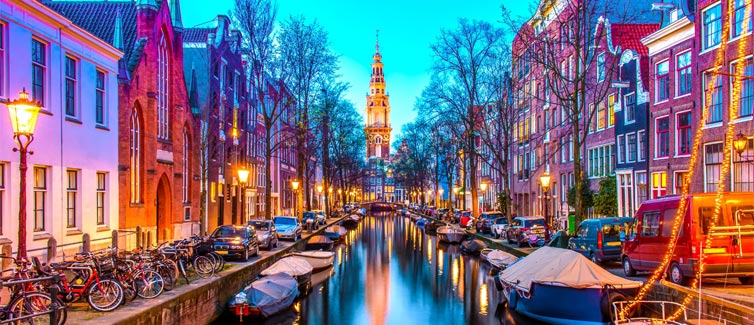
The Netherlands, also informally known as Holland, is part of mainland Europe. The country is home to around 17.6 million people, and has a large international population. A founding member of many international and intergovernmental organisations, the Netherlands is an important and influential country.
The Netherlands was one of the first non-native English speaking countries to offer courses taught in English to international students. You will have the option to study in either English or Dutch, depending on your language proficiency. The people of the Netherlands have a long standing reputation for being very tolerant and open minded, meaning that you will find yourself in a welcoming and diverse environment.
There are two types of higher education institutions in the Netherlands: universities of applied sciences (hogescholen; HBO), and research universities (universiteiten; WO). A university of applied sciences normally offers courses to prepare students for a specific vocation, whereas a research university offers more general courses. Both universities award globally recognised degree classifications.
Universities in the Netherlands are well ranked on the global stage. You will find 13 Dutch universities (not including universities of applied sciences) in the 2023 QS World University rankings top 500, with the University of Amsterdam being the highest ranked in 58th place. The next highest ranked is Delft University of Technology, which is in =61st place.
The Netherlands has welcoming cities all over, these include Amsterdam, Leiden, Rotterdam and Utrecht.
International students who wish to study in the Netherlands will need to obtain a student visa. More information about this can be found in our Netherlands Student Visa Guide.
Bachelor of Business Administration BBA
IC University of Applied Sciences – Amsterdam Netherlands
Find out more
Global Project and Change Management BBA
Windesheim University of Applied Sciences Netherlands
Find out more
Double Bachelor in Econometrics and Philosophy of Econometrics BA/BSc Combined Honours
Erasmus School of Economics Netherlands
Find out moreCan I study in the Netherlands for free?
Public higher education is government subsidised in the Netherlands, meaning that international students from the EU/EEA pay a fixed fee each year. This fee is normally updated every year, in line with inflation and the general cost of living. If you are from a country outside of the EU/EEA, your tuition fee is not fixed, and universities can charge you more. If you study at a private university, your tuition fees can be higher, regardless of where you are from.
Can I study in the Netherlands as an international student?
The Netherlands has a large international population, and this translates into its student population. As a founding member of many international organisations, the Netherlands is very welcoming to all international students. As an international student, you will likely need to obtain a visa in order to study in the Netherlands. For more information about this, take a look at our Netherlands Student Visas article.
Can I study in the Netherlands with English?
The Netherlands is a country that is very diverse in terms of the languages spoken and understood. Many Dutch universities offer their courses in English as well as Dutch. If your first language is not English, you will need to provide evidence of your language proficiency. Most Dutch universities accept an IELTS or TOEFL certificate.
| Capital City | Amsterdam |
|---|---|
| Currency | EUR, Euro |
| Language(s) | Dutch |
| Universities on StudyLink | 41 universities |
| Major Student Cities | Leiden, The Hague, Rotterdam, Utrecht |
The national language of the Netherlands is Dutch. There are also 3 other co-official languages, and 5 more recognised languages.
It is very common for degrees at Dutch institutions to be offered in both Dutch and English. If you choose to study in a non-native language, you will likely have to provide evidence of your language proficiency. The level of proficiency will be determined by your specific institution, so please contact them for more information. If you do not meet the language requirements, your institution of choice may offer language courses to help you improve.
Even if you are able to study in English, you should still take the opportunity to learn as much Dutch as possible. Communicating with locals and other students is a great way to practice. This is a skill that will make your life in the Netherlands easier, but will also look fantastic on your CV/resume!

Erasmus School of Economics, Rotterdam
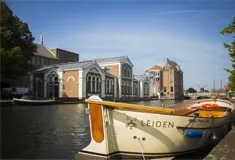
Webster Leiden Campus, Leiden

HAS green academy, 's-Hertogenbosch

University of Groningen, Groningen
Sign up to StudyLink.com, the home of quality study abroad advice.
Sign up now
The latest articles from study abroad providers and StudyLink.com to hep you on your study abroad journey.